

No products in the cart.


Rife frequency therapy
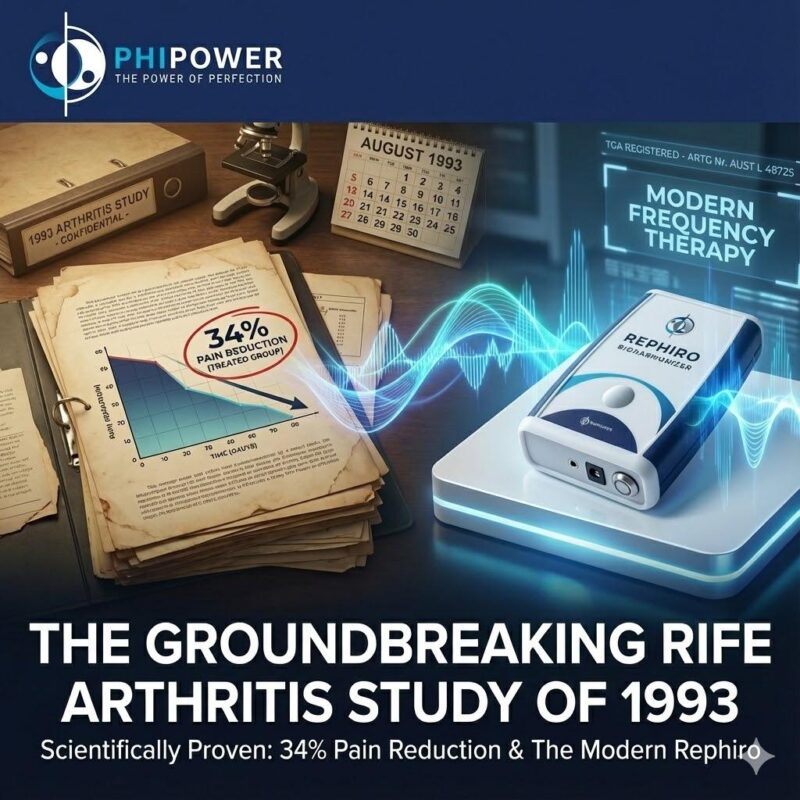
The Groundbreaking 1993 Rife Arthritis Study: When Frequency Therapy Passed the Scientific Test
07
Jan
Jan
The Groundbreaking 1993 Rife Arthritis Study: When Frequency Therapy Passed the Scientific Test ????.
How an Australian Placebo-Controlled Study Demonstrated 34% Pain Reduction with Audio Frequency Therapy – And What This Means for Modern Frequency Devices
In the world of alternative health, skeptics often ask: “Where is the scientific evidence?”
For frequency therapy, one answer lies in Australia, 1993. A rigorous placebo-controlled clinical trial – the gold standard in medical research – showed significant benefits for arthritis patients who used Rife-like audio frequency technology.
This was not a testimonial. This was not anecdotal evidence. This was 49 volunteers, three months of treatment, controlled conditions, and blood tests – all under scientific supervision.
The results? Convincing enough to obtain TGA (Therapeutic Goods Administration) registration in Australia – official government approval that the device delivers what it promises.
Let’s dive into what this groundbreaking study discovered, and why it is still relevant today for anyone interested in frequency therapy.
???? Table of contents
- Study Background: Who, What, When
- The Methodology: Why This Study Is Important
- The Results: Figures That Speak
- Blood test: Objective Evidence
- What This Means for Frequency Therapy
- From 1993 to Today: The Rephiro Connection
- Conclusion
- Sources & Further Reading
- Important Disclaimer
????️ Study Background: Who, What, When
The study was conducted from May 10 to Aug. 14, 1993, at the Tuggerah Lakes Community Centre on the Central Coast of New South Wales, Australia.
The Organization Behind
The research was initiated by BWBGELTECH PTY LTD, led by Geoff Baker (B. App. Sci), Director of Research & Development. Baker had devoted years of his life and considerable resources to studying and perfecting his PET (Pulsed Electro-Therapy) device.
The study included collaboration with:
- Interested Australian Medical Specialists and General Practitioners
- Australian Biologics Testing Services (Sydney) for independent blood analysis
- An arthritis support organization to recruit volunteers
The Participants
The study recruited 49 randomly selected volunteers on those members:
- Chronic Rheumatoid Arthritis – an autoimmune disorder
- Chronic Osteoarthritis – degenerative joint disease
All participants experienced prolonged, persistent joint pain and inflammation – not mild or temporary symptoms.
The Device
The study used 34 Audio Frequency Therapy Units (AFTUs) – pocket-sized, computerized devices that applied specific frequency programs via contact electrodes. This device later became the PET unit, which eventually achieved TGA registration (ARTG No. AUST L 48725) for arthritic therapy in Australia.
???? Why This Is Important: This was not a hobbyist experiment. It was a formal clinical trial designed to meet Australian regulatory standards – specifically to gain government approval for the sale of medical devices.
???? The Methodology: Why This Study Is Important
What makes this study particularly valuable is its rigorous methodology.
Double-blind, Placebo-Controlled Design.
The study used what scientists consider the gold standard for clinical trials:
- Double-blind: Neither patients nor practitioners knew who was receiving real treatment
- Placebo-controlled: Some participants received non-functioning devices
- Random assignment: Volunteers were randomly assigned to treatment or placebo group
This design eliminates both the placebo effect (patients improve because they believe they are being treated) and investigator bias (practitioners unknowingly favoring certain patients).
Treatment protocol
| Parameter | Details |
|---|---|
| Duration | 3 months (May-August 1993) |
| Session frequency | 3 treatments per week |
| Session duration | 3 hours per session |
| Total Treatments | ~36 sessions over 12 weeks |
| Administration method | Contact electrodes (pad device) |
Measurement methods
The researchers used multiple approaches to measure outcomes:
- Visual Analog Scales (VAS) – Standard hospital protocol for self-reported pain monitoring
- HLB Blood Test – Independent laboratory analysis of inflammatory markers
- GP evaluation – Post-study medical assessment by the GP of each volunteer
- Written Testimonials – Qualitative feedback from participants
???? The Results: Figures That Speak
After three months of treatment, the results were clear and statistically significant.
Pain Reduction Results
| Group | Participants | Mean Pain reduction |
|---|---|---|
| Group Treated | 28 volunteers | 34% reduction |
| Placebo group | 21 volunteers | 13% reduction |
| Net Difference | – | 21% greater improvement |
Understanding the Placebo Effect
The 13% improvement in the placebo group was actually expected and validates the study design. As the researchers noted:
“The average 13 percent pain reduction in the untreated volunteers was generally attributable to the emotional benefits of participating in the study. This improvement was not confirmed in blood test results.”
In other words, patients in the placebo group felt better because someone was paying attention to them – but their bodies showed no objective improvement. The treated group showed both subjective improvement (how they felt) ALSO objective improvement (what blood tests showed).
Non-Responders: Important Context
Not everyone improved. The researchers were transparent about this:
- Some participants had advanced joint degeneration (joint replacement in prospect)
- Pain was sometimes related to unrelated diseases
- Late-stage chronic arthritis patients may need longer treatment periods
This honesty actually reinforces the credibility of the study – they did not claim universal success.
???? Blood tests: Objective Evidence Beyond Self-Reporting
The most compelling aspect of this study was not what patients said – it was what their blood showed.
HLB Blood Analysis
Australian Biologics Testing Services in Sydney conducted pre- and post-study HLB (Heitan-LaGarde-Bradford) testing on randomly selected volunteers from both groups.
The HLB test measures ROTS masses – indicators of inflammatory oxidative processes in the extremities, which directly correlates with the severity of arthritis.
???? What HLB Tests Reveal:
High oxidative states = increased inflammation = more severe arthritis
Lower oxidative states = decreased inflammation = improved condition
HLB Blood Test Results
| Group | Tested Participants | Change in ROTS Masses |
|---|---|---|
| Group Treated | 8 volunteers | 26% decrease (improvement) |
| Placebo group | 7 volunteers | 1% increase (slight worsening) |
| Net Difference | – | 27% improvement difference |
The Meaning of Blood Evidence
These blood test data are crucial because they provide objective, measurable evidence that could not be influenced by patient expectations or placebo effect.
The researchers noted the remarkable consistency:
“The net average pain reduction of the treated volunteers compared to the untreated group was 21 percent, matching well with the net average 26 percent reduction in oxidative processes in the treated versus untreated groups.”
In other words, subjective pain reports matched objective blood measurements. Patients did not imagine their improvement – their bodies actually changed.
???? What This Means for Frequency Therapy
This study is significant for several reasons that extend far beyond arthritis treatment.
1. Scientific Validation of the Approach.
The researchers concluded:
“The results of the study suggest that Audio Frequency Therapy offers an effective non-medicated alternative in the treatment of chronic Osteo and Rheumatoid Arthritis with minimal short-term side effects.”
This is a scientifically verified, rigorous statement – not a marketing claim.
2. Government approval
The study enabled the device to obtain TGA registration (ARTG No. AUST L 48725) in Australia – similar to FDA approval in the United States. The Australian government recognized that the device provided measurable therapeutic benefits.
3. Non-Medicated Alternative.
For millions of arthritis patients, conventional options often mean:
- Long-term medication use with side effects
- Increasing drug doses
- Eventual surgical intervention
This study suggested another path – one that works with the body’s natural systems rather than overwriting them with chemicals.
4. Foundation for Modern Research.
One of the few rigorous placebo-controlled studies of Rife-like frequency therapy, this 1993 Australian study provides a foundation for understanding how and why frequency therapy can be effective.
???? From 1993 to Today: The Rephiro Connection
The 1993 study used technology that was revolutionary for the time – pocket-sized computerized devices that delivered specific frequency programs via contact electrodes.
Three decades later, that technology has evolved.
The Technological Parallel
The principles demonstrated in the Australian study correspond directly to modern frequency devices such as the Rephiro Bioharmonizer:
| Feature | 1993 PET Device | Rephiro Bioharmonizer |
|---|---|---|
| Method of administration | Contact electrodes (pads) | Contact electrodes (silver fiber socks/tapes) |
| Format | Pocket size computerized unit | Phone size integrated unit |
| Programming | Preprogrammed frequency menus | Pre-programmed broadband sweep |
| Frequency Type | Audio frequencies | Audio frequencies with RF carrier wave |
| User Experience | Select program, apply | One-button operation |
What the Rephiro Adds
Building on the foundation laid by devices such as the PET, the Rephiro integrates:
- ✅ Hoyland sideband method – wider frequency coverage without manual programming
- ✅ 3.1 MHz carrier wave – deeper tissue penetration
- ✅ 14 Hz pump wave – enhanced cellular resonance
- ✅ 0.1-150 kHz sweep – full spectrum coverage
The core principle remains identical: deliver therapeutic frequencies through direct contact to support the body’s natural processes.
Accessibility Revolution
In 1993, obtaining TGA registration required significant investment. The technology was available primarily through clinical settings and specialized practitioners.
Today, the Rephiro Bioharmonizer brings equivalent (and improved) technology to home use:
- ✅ €199 – accessible to individuals, not just clinics
- ✅ No subscription – one-time purchase
- ✅ Plug and play – no technical training required
- ✅ Complete system – device + electrodes + manual included
✅ Conclusion: Evidence That Matters
The 1993 Australian Arthritis Study stands as one of the most rigorous scientific studies of Rife-like frequency therapy ever conducted.
Main conclusions:
- ✅ Placebo-controlled design eliminated bias and expectancy effects
- ✅ 34% pain reduction in treated group vs. 13% in placebo
- ✅ 26% reduction in inflammatory blood markers confirmed objective improvement
- ✅ TGA government approval validated therapeutic claims
- ✅ Minimal side effects reported during short-term use
This study shows that frequency therapy is not just about “good vibrations” or placebo effects. When properly designed and applied, audio frequency therapy can produce measurable, objectively verifiable improvements in chronic conditions.
Technology has advanced since 1993, but the fundamental principle remains the same: frequencies can support the body’s natural ability to recover.
???? Ready to Experience Modern Frequency Therapy?
The Rephiro Bioharmonizer builds on the foundation laid by studies such as the 1993 Australian study – with three decades of technological advances.
What you get:
- Fully integrated system (pump wave + frequency generator)
- Complete frequency coverage via Hoyland sideband method
- Silver fiber socks & wristbands for contact administration
- Comprehensive manual with protocols
- 1 year manufacturer’s warranty
€199 – complete, no hidden fees, no subscriptions
???? Sources & Further Reading
Primary Study Documentation
- A Placebo Study of Audio Frequency Therapy in the Treatment of Arthritis – Full Study Report (PDF)
- Newspaper articles on the Arthritis Study – Contemporary media reports (PDF)
- Royal Rife Research Europe – Arthritis Study Overview
Scientific Background
- Meessen, A. (2020). Virus Destruction by Resonance. – Journal of Modern Physics, demonstrates frequency resonance effects on microorganisms
- Scientific Research on Rife Technology – Royal Rife Research Europe compilation
Related Articles on PhiPower.org
- The Science of Cellular Resonance
- How Does the Hoyland Sideband Method Work?
- Do Rife Frequencies Cause Detoxification?
- Does Frequency Therapy Affect Your Good Bacteria?
Historical Rife Documentation
- History of Rife Instruments – Royal Rife Research Europe
- Who Was Royal Raymond Rife? – Biographical overview
⚠️ Important Disclaimer
The Rephiro Bioharmonizer is an electronic examination and wellness device for personal well-being. It supports your body’s natural processes but does not replace medical treatment.
- The 1993 Australian study is historical documentation; results may vary
- The Rephiro is positioned as a wellness device, not a medical device
- Not intended to diagnose, treat, cure or prevent disease
- Do not use with pacemaker or during pregnancy
- Always consult your health care provider with medical concerns
- Use on your own responsibility
Frequency therapy is complementary and should not replace professional medical advice, diagnosis or treatment. The historical study described in this article used a different device than the Rephiro; we present it for educational purposes to demonstrate the scientific foundation of audio frequency therapy principles.
Scientific foundation. Modern implementation. Your natural wellness journey.
