

No products in the cart.


Vital Water
Influence of LED light on water: how LED frequencies (405-850 nm) affect your drinking water
26
Jan
Jan
Water is the foundation of all life. But what if we could not only purify water, but also vitalize it with light? In this blog, we dive deep into the science behind LED light frequencies and their effects on drinking water. We examine four specific wavelengths: violet (405 nm), blue (470 nm), red (660 nm), and near-infrared (850 nm). Which effects are scientifically proven? And which claims remain hypothetical?
How does light act on water?
When light travels through water, it is partially absorbed by the water molecules. The degree of absorption depends on the wavelength. Shorter wavelengths (violet/blue) penetrate deeper into pure water, while longer wavelengths (red/infrared) are absorbed more strongly and therefore have a greater influence on the molecular structure of water.
This phenomenon forms the basis for photobiomodulation and water structuring. By applying specific light frequencies, we can influence the physical and chemical properties of water — from disinfection to energetic activation.
???? Violet Light (405 nm): The Purifier
Violet light is located on the boundary between the ultraviolet and visible spectrum. This wavelength is known for its powerful antimicrobial properties — without the risks of UV radiation.
Physical effects on water
Water is extremely transparent at 405 nm. The absorption minimum of pure water lies around 418 nm, which means that violet light has a penetration depth of 100-200 meters in pure water. This makes it ideal for treating larger volumes of water.
Chemical effects
The most significant effect occurs in the presence of microorganisms. Violet light (405 nm) excites endogenous porphyrins in bacteria. This leads to the formation of Reactive Oxygen Species (ROS) such as singlet oxygen (¹O₂), hydrogen peroxide, and hydroxyl radicals. These ROS cause oxidative stress in the cell walls of pathogens, thereby inactivating them.
✅ Scientifically proven:
- Effective inactivation of pathogens such as E. coli, S. aureus, and Listeria
- Safe for human exposure at correct dosages (unlike UV-C)
- Degradation of dissolved organic substances via photochemical oxidation
⚠️ Hypothetical: Claims that 405 nm light makes water “vital” independently of the purifying effect often fall under marketing without direct physical substantiation.
Application: Continuous disinfection of drinking water, surface treatment, and food processing.
???? Blue Light (470 nm): The Supporting Power
Blue light shares properties with violet light but has a lower photon energy. The attenuation length in water is approximately 50-65 meters.
Chemical effects
Blue light (470 nm) also exhibits antimicrobial effects, although less efficiently than 405 nm. The excitation of porphyrins is less optimal at this wavelength. However, it has been shown that blue light can inhibit specific biological processes, such as fungal development and biofilm formation.
✅ Scientifically proven:
- Effective against specific bacteria such as P. aeruginosa and S. aureus
- Inhibition of biofilm formation
- Enhanced effect in combination with photosensitizers (such as riboflavin)
⚠️ Hypothetical: Associations with “freshness” and “calmness” are likely based on chromotherapy or effects on the circadian rhythm, rather than measurable changes in the water physics itself.
Application: Supporting disinfection and treatment of superficial infections.
???? Red Light (660 nm): The Harmonizer
Red light plays an essential role in photobiomodulation (PBM) and interacts with matter differently than shorter wavelengths.
Physical effects on water
Absorption at 660 nm is dominated by vibrational overtones of the O-H bonds in water molecules. Absorption here is approximately 100 times greater than at 405 nm. In water, red light has an attenuation length of about 2.0-2.5 meters.
Biochemical effects
The primary effect — especially relevant when water is absorbed by biological systems — is the stimulation of the enzyme cytochrome c oxidase (CCO). This increases ATP production and can release nitric oxide (NO), which improves blood circulation.
✅ Scientifically proven:
- Promotion of cell metabolism and wound healing via PBM
- Stimulation of root growth and photosynthesis in plants
- Increased ATP production in cells
⚠️ Hypothetical: The claim that irradiating water with 660 nm before consumption “harmonizes” the water or gives it a lasting vibrational signature is theoretical and not widely accepted in mainstream physics.
Application: Skin rejuvenation, wound healing, and support of water structure in the Phipower Vital Water Maker.
⚫ Near-Infrared (850 nm): The Structurer
This is the most crucial wavelength for claims regarding “structured water” and physical modification. NIR light penetrates deep into biological tissue (30-50 mm) and plays a key role in the formation of the so-called Exclusion Zone (EZ).
The Exclusion Zone: Fourth Phase of Water
Research by Dr. Gerald Pollack at the University of Washington shows that infrared light organizes water molecules into a liquid-crystalline, hexagonal structure near hydrophilic surfaces. This water — also known as H₃O₂ — has unique properties:
- Negative charge: EZ water acts as a natural reducing agent (antioxidant)
- Battery effect: The process separates charges, similar to a biological battery
- Lower viscosity: Theoretically, this improves cellular processes such as ATP rotation
✅ Scientifically proven:
- Infrared radiation expands the Exclusion Zone at surfaces (peer-reviewed)
- Deep tissue stimulation, pain relief, and muscle recovery via PBM
- NIR penetrates 30-50 mm into human tissue
⚠️ Point of debate: Critics argue that the structured H₃O₂ phase is unstable without a stabilizing hydrophilic surface. The EZ would quickly revert to bulk water once the energy source is removed. The Phipower Vital Water Maker therefore combines NIR light with a magnetic vortex, which is claimed to stabilize the structure.
Application: Deep cell activation and the energetic activation of water in vitalization systems.
???? Overview: Science vs. Theory
| Wavelength | Primary Mechanism | Status | Application |
|---|---|---|---|
| 405 nm (Violet) | Excitation of porphyrins → ROS | PROVEN | Pathogen disinfection |
| 470 nm (Blue) | Weaker ROS formation | PROVEN | Supporting disinfection |
| 660 nm (Red) | O-H vibration / CCO activation | PBM PROVEN WATER: THEORY | Energetic activation |
| 850 nm (NIR) | EZ formation / Viscosity reduction | EZ PROVEN STABILITY: DEBATE | Water structuring (EZ/H₃O₂) |
???? The Phipower Vital Water Maker: Four Frequencies in One System
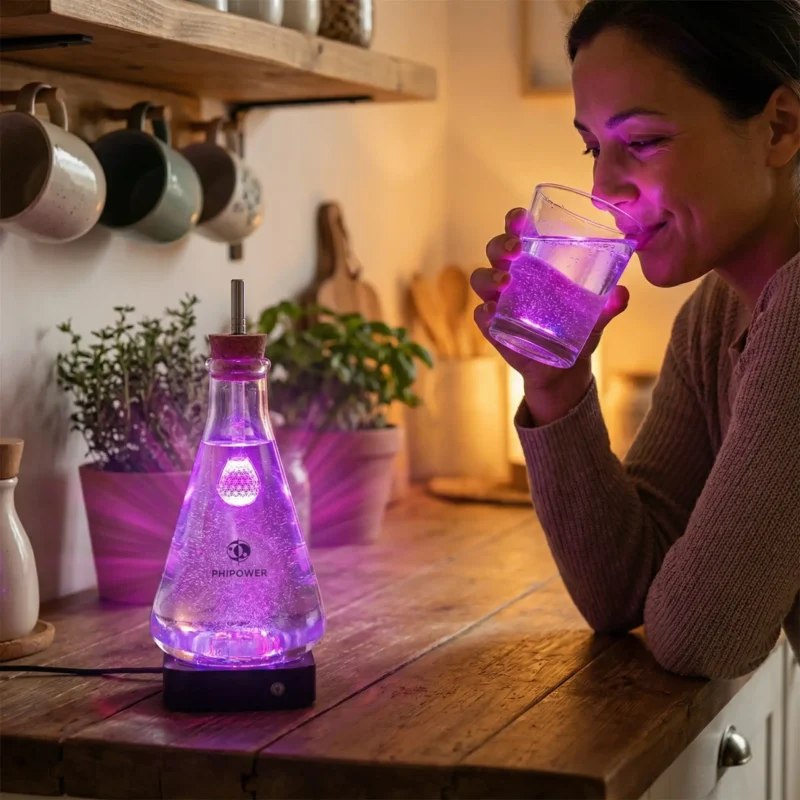
The Phipower Vital Water Maker combines all four discussed light frequencies into one innovative system:
- ✅ Violet light (405 nm) — Purifying influence on pathogens
- ✅ Blue light (470 nm) — Enhancement of biological activity
- ✅ Red light (660 nm) — Support of water structure
- ✅ Near-infrared (850 nm) — Deep energetic activation and EZ formation
By combining these four frequencies with a magnetic vortex (inspired by Viktor Schauberger’s insights on natural water movement), a holistic effect is created. The system aims for both purification (via 405/470 nm) and structuring (via 660/850 nm + vortex).
Important nuance: While the disinfecting effect of violet and blue light is chemically well understood, the structuring aspect relies on the fascinating — but sometimes controversial — physics of the “fourth phase” of water. Phipower presents this honestly: the science is evolving, and we closely follow the latest insights.
Discover the Phipower Vital Water Maker
Combine the power of four light frequencies with vortex technology for more vital water.
???? Related articles
- 10 Benefits of Structured Water: Discover the Power of Optimization for Your Health
- Bovis Value and Vitalized Water
- Do Rife Frequencies Cause Detoxification? The Science Behind Microbial Die-Off
- Does Frequency Therapy Affect Your Good Bacteria?
Scientific sources
- Maclean, M. et al. (2010).
Environmental decontamination of a hospital isolation room using high-intensity narrow-spectrum light.
Journal of Hospital Infection, 76(3), 247-251. - Guffey, J.S., & Wilborn, J. (2006).
In vitro bactericidal effects of 405-nm and 470-nm blue light.
Photomedicine and Laser Surgery, 24(6), 684-688. - Sommer, A.P. et al. (2015).
Mitochondrial mechanisms of photobiomodulation in context of new data about interfacial water layers.
Photomedicine and Laser Surgery, 33(3), 164-167. - Hamblin, M.R. (2017).
Mechanisms and applications of the anti-inflammatory effects of photobiomodulation.
AIMS Biophysics, 4(3), 337-361. - D’Souza, C. et al. (2015).
Applications of light-emitting diodes (LEDs) in food processing and water treatment.
Food Engineering Reviews, 7(2), 212-227. - Pope, R.M., & Fry, E.S. (1997).
Absorption spectrum (380–700 nm) of pure water. II. Integrating cavity measurements.
Applied Optics, 36(33), 8710-8723.
Disclaimer: The Phipower Vital Water Maker is a device for personal well-being and research. It is not a medical device, and the information in this article does not replace professional medical advice. Always consult a physician for health-related questions.
