Structured Water: The Complete Guide to Science, Vortexing, EZ Water & Vitalization
What does "structured water" actually mean? This guide separates the real molecular structure of liquid water from wellness terminology, examines hexagonal water, H3O2, EZ water, vortexing and nanobubbles, and explains where vitalized water and the Water Vitalizer fit into the picture.
By Phipower·22 min read·Updated August 2026·Pillar guide
Water has genuine molecular structure — but that is not the same as proving every commercial claim about "structured water".
What is structured water?
Structured water is a broad term for water claimed or intended to have a more ordered molecular or physical organization than ordinary bulk water. Science confirms that liquid water has dynamic local structure and behaves differently near some interfaces, but stable "hexagonal water" in a bottle and specific health benefits from consumer structuring methods have not been established.
Three things to remember✓ Water is molecularly structured — dynamically.✓ Vortex flow can measurably change some water properties temporarily.✕ That does not prove permanent health-enhancing "hexagonal water".
What does "structured water" mean?
The phrase structured water is used in two very different ways, and much of the confusion begins there.
In physical chemistry
Water has local structure
Liquid water is a dynamic hydrogen-bonded network. Molecules adopt local arrangements, break hydrogen bonds and form new ones continuously. Scientists study this structure because it helps explain water's unusual properties.
In wellness
"Structured" usually means treated water
The term is often used for water exposed to vortexing, magnets, light, minerals, crystals or other methods with the intention of changing how the water is organized or experienced.
Those meanings overlap linguistically, but they are not scientifically interchangeable. The fact that liquid water has structure does not by itself demonstrate that a household device can lock litres of drinking water into a permanently different molecular phase.
Where Does the Idea of Structured Water Come From?
The modern concept of structured water brings together historical observations, scientific research and more recent wellness interpretations.
In the early twentieth century, Austrian naturalist and inventor Viktor Schauberger emphasized the importance of natural water movement. His ideas about spiral flow, vortices and water quality continue to influence the design philosophy behind many contemporary water-vitalization devices.
Later, terms such as hexagonal water and energized water became popular in wellness marketing. These concepts often suggest that water can retain a special molecular arrangement after treatment, although such claims generally lack convincing scientific evidence.
A more experimentally grounded line of research emerged from studies of water near material surfaces. In 2003, Gerald Pollack and colleagues published observations of particle-exclusion zones near hydrophilic materials. Pollack subsequently proposed that these observations might indicate an additional, ordered phase of water, an interpretation popularized in his 2013 book The Fourth Phase of Water.
The exclusion phenomena are scientifically interesting, but their underlying mechanisms remain debated. The proposed fourth phase is not an established property of ordinary drinking water.
The key distinction: historical inspiration, experimentally observed phenomena and claims about health benefits are three different levels of evidence. Understanding the distinction is essential to evaluating structured water responsibly.
Water is already structured — but dynamically
A useful starting point is to forget the idea that ordinary liquid water is a completely random collection of isolated H₂O molecules. It is not. Water molecules interact strongly through hydrogen bonds, producing a constantly changing network with local tetrahedral and other arrangements.
Modern spectroscopy and molecular modelling show that this network is highly dynamic. Local structures exist, but they continuously reorganize as molecular partners change. That is why the most scientifically accurate question is not "is water structured?" — it is what type of structure, at what scale, under what conditions, and for how long?
Why this distinction matters
Claims such as "water has molecular structure" can be scientifically true while claims such as "this bottle now contains permanently hexagonal water that hydrates cells better" remain unproven. A trustworthy discussion of structured water must keep those two statements separate.
Hexagonal water: what is the claim?
"Hexagonal water" is one of the most common phrases used alongside structured water. The idea is usually that water molecules can be organized into six-sided clusters resembling the geometry found in ice or other ordered forms, and that this arrangement remains stable after treatment.
Hexagonal motifs can certainly occur in hydrogen-bonded water structures. The issue is permanence. At ordinary drinking-water conditions, the hydrogen-bond network is continually rearranging. There is no accepted evidence that a consumer treatment produces a stable bulk phase of permanently hexagonal drinking water that then delivers specific health benefits.
Claim versus evidence
Statement
Current position
Liquid water has local molecular structure
Established
Interfaces can influence nearby water
Established
Household treatment creates permanent bulk hexagonal water
Not established
Permanent hexagonal structure improves human hydration
Not established
EZ water, Gerald Pollack and H₃O₂
One of the most influential modern ideas in the structured-water world comes from Professor Gerald Pollack and colleagues at the University of Washington. Their experiments describe exclusion zones (EZs) next to certain hydrophilic surfaces — regions from which suspended particles are excluded.
Pollack's group has reported charge separation and expansion of these zones under radiant energy. Pollack has proposed that EZ water may have a more ordered arrangement and has popularized an H₃O₂-like structural description.
The important nuance is that the exclusion-zone phenomenon itself has been observed by multiple groups, while the explanation remains debated. A critical review found that alternative mechanisms such as diffusiophoresis can explain key observations and noted that evidence does not establish Pollack's proposed large-scale phase or hexagonal structure.
What is interesting
Water near interfaces can behave differently from bulk water, and exclusion-zone experiments raise legitimate physical questions.
What is not proven
That litres of bottled drinking water become a stable H₃O₂ phase after vortexing, light exposure or other consumer treatment.
Vortexing is one of the most popular methods associated with structured and vitalized water. It is also one of the easiest aspects to discuss without relying on speculative chemistry, because a vortex is a real fluid-dynamic phenomenon you can see and measure.
Rotational flow changes velocity, pressure, mixing and gas exchange within the liquid. A 2024 study of a specific vortex–swirl device found that the process created a large population of approximately 1 μm microbubbles and temporarily altered properties including dissolved oxygen and pH. The bubble population decayed over hours. A blind panel in the same study also rated the processed water as fresher and less "thick" than untreated water.
The scientifically safer interpretation
Vortexing can produce measurable, time-dependent changes in water under particular conditions. That is interesting in its own right. It does not require claiming that every vortex permanently restructures H₂O molecules or creates a new biological form of water.
Vortexing as a daily ritual: the measurable effects and the personal experience are two different questions.
Microbubbles and nanobubbles: a measurable bridge
Tiny gas bubbles are one of the most useful bridges between traditional descriptions of "living" or "vital" water and measurable water engineering. Microbubbles and bulk nanobubbles are real research fields, with applications in gas transfer, agriculture, aquaculture, cleaning and water treatment.
Their unusual behaviour comes from their small size, gas–liquid interface and, in some systems, surface charge. Research has reported populations of very small bubbles that persist much longer than ordinary visible bubbles.
But again, terminology matters: nanobubble water is not automatically the same thing as structured water. A sample can contain micro- or nanobubbles without proving a permanent rearrangement of the surrounding H₂O network.
Can light influence water?
Water interacts with electromagnetic radiation in wavelength-dependent ways. Infrared absorption, vibrational spectroscopy and interfacial effects are standard areas of water science. Pollack's group also reported that radiant energy expanded exclusion zones in their experimental system.
What should not be assumed is that shining a therapeutic wavelength through a carafe transfers the established biological effects of direct photobiomodulation of tissue into the water for later consumption. Those are different experimental questions.
The Phipower Water Vitalizer uses four defined LED wavelengths — 405, 470, 660 and 850 nm — as part of the water-preparation ritual. We present these as precisely specified light inputs, not as proof that illuminated water becomes a medical treatment.
Magnetic water treatment has been investigated for industrial effects such as scaling and crystallization, but results vary significantly with field strength, water chemistry and experimental design. That is not the same as established evidence for general health benefits from magnetically "structured" drinking water.
Crystals belong to a different category again. Amethyst, clear quartz and rose quartz — the traditional Golden Triangle — are included with the Phipower Water Vitalizer as a symbolic and aesthetic part of the ritual. Their traditional energetic meanings should be distinguished from established medical science.
For the new Phipower knowledge architecture, these terms have deliberately different jobs.
Term
What it means on Phipower
Structured water
The broad concept: molecular structure, interface science, EZ water, H₃O₂, vortexing, bubbles and competing interpretations.
Vitalized water
A practical wellness term for water deliberately prepared through movement, light and ritual.
Water Vitalizer
The device category used to prepare vortexed/vitalized water.
Phipower Water Vitalizer 2 Litre
Phipower's specific 2-litre product.
In other words: if you want to understand the science and controversy, stay on this page. If you want to understand the practice of vortexing, light and ritual, continue to our complete guide to vitalized water.
From concept to experience
Want to experiment with vortexed water yourself?
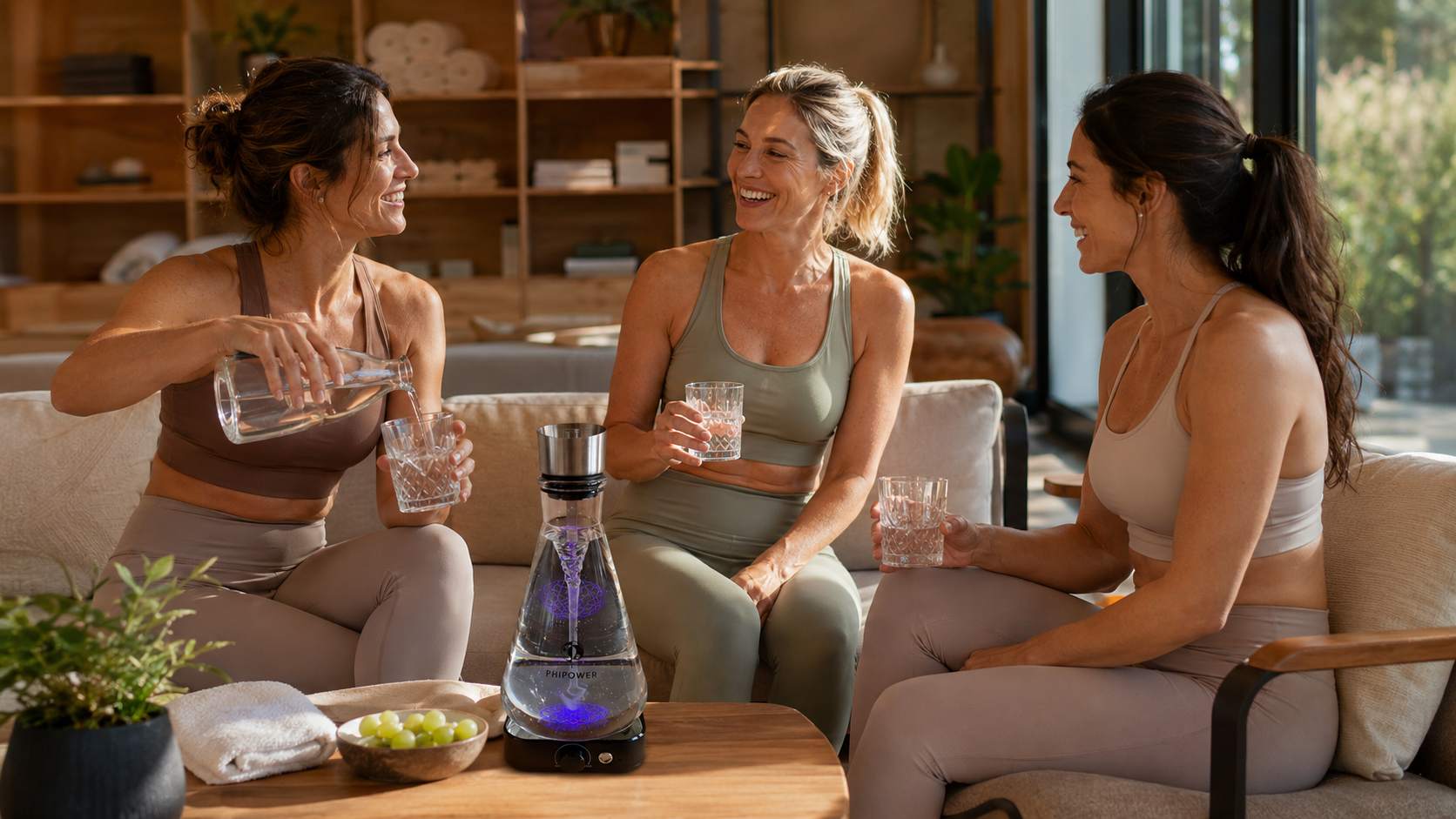
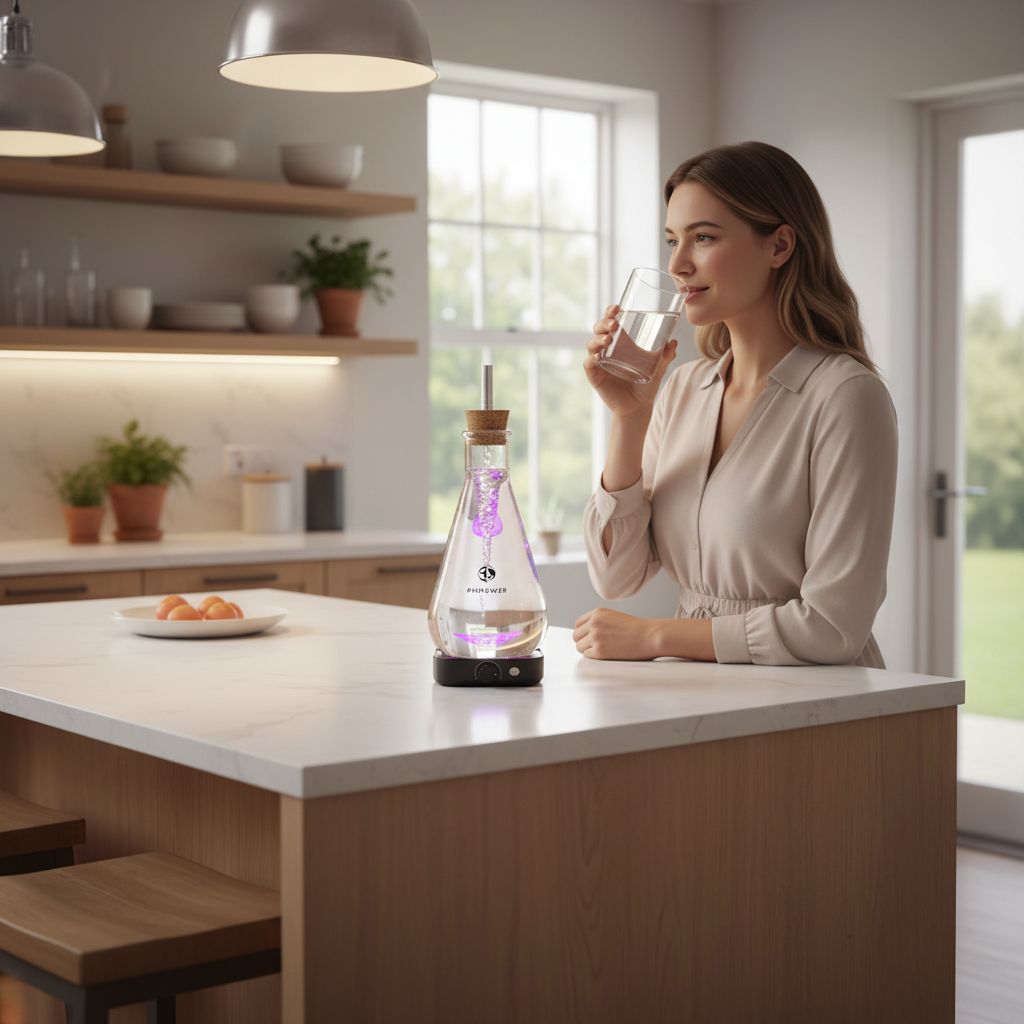
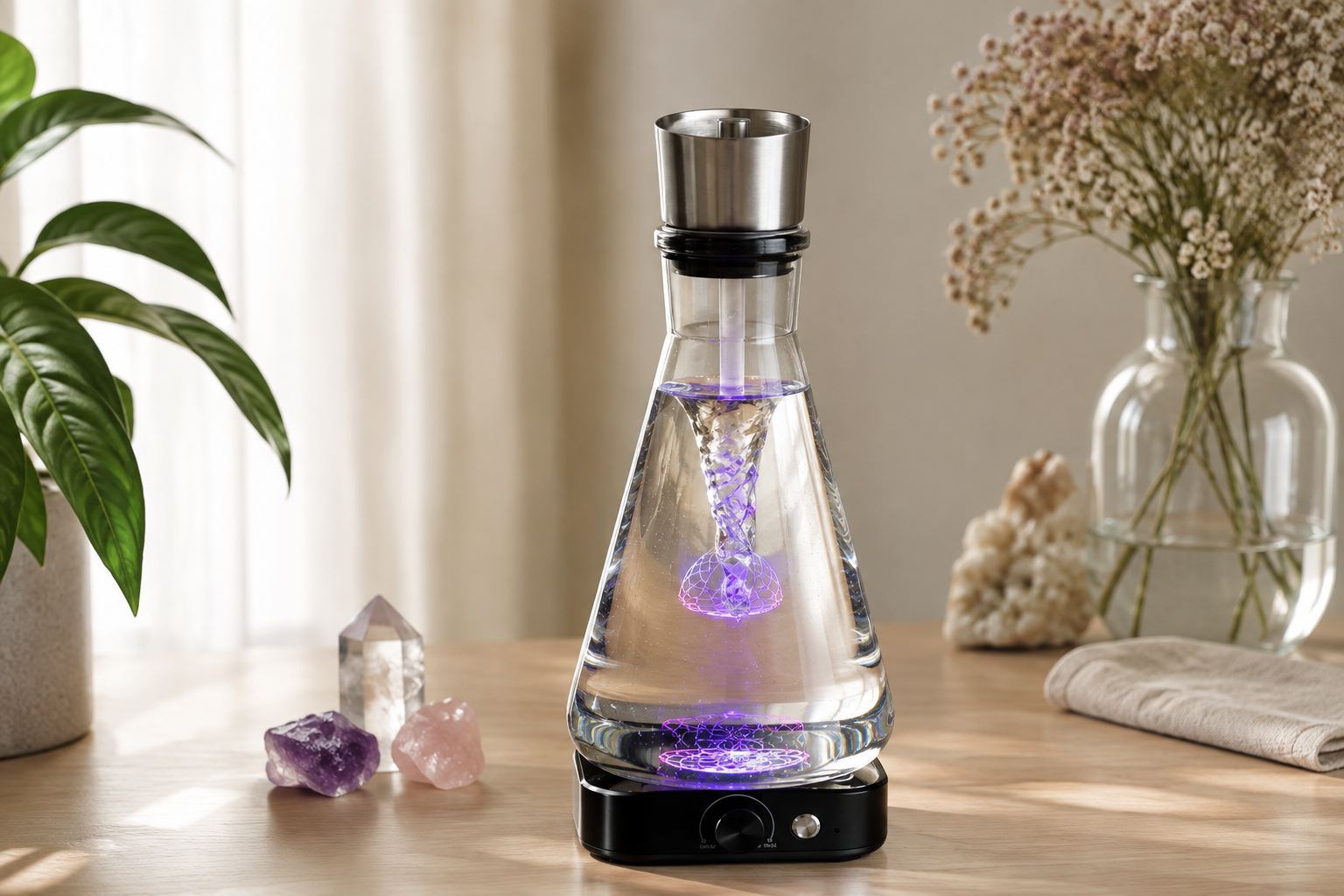
The Phipower Water Vitalizer 2 Litre combines an adjustable magnetic vortex, four LED wavelengths, a handmade 2-litre borosilicate carafe and Golden Triangle crystals in one countertop system.
Structured water vs. filtered, alkaline and hydrogen water
Is structured water actually different from ordinary tap, filtered or bottled water? The answer depends on what we mean by different. All these water types consist primarily of H₂O molecules. What can vary is their mineral content, dissolved gases, contaminants, treatment methods and certain measurable physical properties.
The term structured water is different: it is not a standardized drinking-water category, and the claim that household treatments create a stable, health-enhancing molecular structure has not been scientifically established.
Comparing common types of drinking water
Water type
What makes it different?
Evidence-based conclusion
Tap water
Mineral composition and treatment depend on the local water supply.
A practical, affordable choice when it meets drinking-water safety standards.
Filtered water
Depending on the filter, specific contaminants, tastes or odours may be reduced.
Useful when filtration addresses a specific water-quality concern.
Bottled water
Mineral content, source, packaging and quality vary.
Convenient, but not automatically safer or healthier than suitable tap water.
Vortexed or vitalized water
Rotational movement can influence mixing, gas exchange and bubble formation under certain conditions.
A measurable physical process and enjoyable preparation ritual; superior health benefits remain unproven.
Structured water
A broad term suggesting altered molecular organization, often through vortexing, magnetic fields or light.
Not a standardized water category; lasting structural changes and clinical benefits require stronger evidence.
Alkaline water
Has a higher pH, sometimes with altered mineral composition.
Its pH can be measured, but higher pH alone does not establish superior health benefits.
Hydrogen-rich water
Contains dissolved molecular hydrogen (H₂).
Dissolved hydrogen can be measured; potential health effects require separate clinical evaluation.
Can vortexing make ordinary water better? Vortexing can change how water moves, mixes and exchanges gases. Research using particular vortex systems has reported temporary changes in measurable water properties and sensory perception. However, these findings do not establish that vortexed water has a permanently altered molecular structure or hydrates the human body more effectively.
The practical conclusion: start with water that is already safe to drink. Filtration addresses water quality; vortexing addresses physical preparation. They serve different purposes and can complement each other.
Structured water benefits: what is claimed and what is proven?
Search for "structured water benefits" and you will encounter claims involving faster hydration, detoxification, energy, improved cellular function and disease prevention. Those claims should not be treated as established simply because a product changes water movement, light exposure or subjective taste.
Common consumer claim
"Structured water enters cells more efficiently because its clusters are smaller."
Evidence: not established as a clinical benefit of consumer structured-water products.
More defensible observation
Specific physical processing can change measurable features such as gas distribution, microbubble populations and, in some systems, taste perception.
Evidence: system-specific and does not automatically translate into health outcomes.
Phipower therefore positions water structuring and vitalization as a wellness and water-preparation practice, not a medical treatment. The strongest reason to explore it is curiosity about water, movement and ritual — not a promise to treat disease.
What Animal and Laboratory Research Actually Shows
Does scientific research show that drinking structured water has biological effects? A 2021 review by Michael I. Lindinger, published in the Journal of Animal Science, examined animal studies involving differently treated water, particularly magnetically treated water.
The review reported potentially beneficial outcomes in several studies, including changes in animal growth, oxidative-stress markers, glucose regulation and blood lipid profiles. However, not all studies demonstrated improvements, and some reported undesirable effects under particular treatment conditions.
Important limitations remain. The studies used different preparation methods, exposure conditions, animal species and outcome measures. The mechanisms behind the reported effects are uncertain, and further standardized research is needed. The review was also produced as part of a commercially funded research contract, which is relevant when evaluating its conclusions.
Crucially, these findings cannot automatically be transferred to humans or to vortex-based consumer products. There is currently insufficient robust clinical evidence that drinking commercially structured or vortexed water provides superior hydration or specific health benefits. Laboratory research on water near surfaces is a separate scientific field and should not be confused with studies of drinking treated water.
Our interpretation: the findings justify further investigation, not established health claims.
Can you make structured water at home?
If by "make structured water" you mean create a scientifically verified new stable molecular phase of bulk H₂O, there is no accepted household method for doing that.
If you mean experiment with physical water treatment, then yes. You can vortex water, expose it to defined light, compare filtered versus unfiltered samples, measure pH or dissolved oxygen, and perform blind taste tests. Those are concrete actions that do not depend on accepting a specific molecular theory.
01
Start with safe water
Filter or purify first if your source water requires it.
02
Create a stable vortex
Use controlled rotational motion rather than relying on an invisible "energy" claim.
03
Compare and measure
Taste blind, record preparation time, or measure properties before and after.
04
Prepare it fresh
Many measurable flow-related effects are transient rather than permanent.
What is a Water Vitalizer?
A Water Vitalizer is a device designed to make water preparation deliberate rather than passive. Different products use different methods; some use mechanical vortexing, others use magnets, minerals, light or combinations of these approaches.
For SEO and user clarity, Phipower treats Water Vitalizer as the commercial device category — separate from the scientific question of whether "structured water" is a stable molecular phase.
The Phipower Water Vitalizer 2 Litre creates a visible adjustable vortex in a handmade 2-litre borosilicate carafe and combines it with four LED wavelengths and the Golden Triangle crystals. It is a wellness product, not a water purifier or medical device.
Phipower Water Vitalizer 2 Litre
Phipower's product page should own the specific product query Phipower Water Vitalizer 2 Litre. This guide only explains why the device is relevant to people researching structured and vortexed water.
There is no scientifically established shelf life for "structured water" because the term does not refer to one standardized measurable state. Claims that a treatment remains encoded indefinitely should therefore be treated cautiously.
Where specific measurable effects exist — such as the microbubble population observed after a particular vortex–swirl process — they may be transient. In the 2024 study discussed above, the measured microbubble population decayed over a timescale of hours.
For a home ritual, the simplest approach is therefore to prepare water relatively fresh rather than assuming that an invisible structure remains unchanged for days.
How can you test structured or vortexed water for yourself?
A useful structured-water experiment starts with a question that can actually be measured. Instead of asking "is the water more alive?", ask something specific.
A simple home comparison
• Same source water• Same temperature• One untreated control• One vortexed sample• Blind taste labels• Repeat on multiple days
For deeper research, parameters such as dissolved oxygen, pH, conductivity, ORP, surface tension and bubble-size distributions can be measured with suitable equipment. Phipower intends to build more original measurement content around these questions rather than relying only on inherited wellness claims.
Frequently asked questions about structured water
Is structured water the same as hexagonal water?+
Not exactly. "Structured water" is the broad umbrella term, while "hexagonal water" is a specific — and unproven — claim that water molecules can be locked into stable six-sided clusters. Liquid water does have dynamic local structure, but no accepted evidence shows a consumer treatment creates a permanent hexagonal phase.
What is EZ water?+
EZ (exclusion zone) water refers to a region next to certain hydrophilic surfaces from which suspended particles are excluded, first described by Professor Gerald Pollack's lab. The exclusion-zone phenomenon itself has been observed by multiple research groups, but the explanation is debated — a critical review found alternative mechanisms such as diffusiophoresis can account for key observations.
Does vortexing water actually change anything measurable?+
Yes, within limits. A 2024 study of a vortex–swirl device found it created a large population of microbubbles and temporarily changed dissolved oxygen and pH, with a blind panel rating the water fresher-tasting. These effects were transient, decaying over hours — not evidence of a permanent new molecular structure.
Are nanobubbles the same as structured water?+
No. Micro- and nanobubbles are a real, separate research field studied for gas transfer, agriculture and water treatment. A sample can contain nanobubbles without that proving any permanent rearrangement of the surrounding water molecules.
Can light really affect water?+
Water does interact with electromagnetic radiation in wavelength-dependent ways, and Pollack's group reported that radiant energy expanded exclusion zones in their experiments. That is different from claiming that shining light through a carafe transfers the effects of direct photobiomodulation of tissue into the water itself.
Are the health benefits of structured water scientifically proven?+
No. Claims about faster hydration, detoxification or disease prevention from structured water are not established in the scientific literature. What is better supported is that specific physical processing — like vortexing — can measurably change transient properties such as gas content and taste perception.
Can I make structured water at home?+
You cannot reliably create a verified new stable molecular phase of water at home. You can, however, experiment with physical treatment — vortexing, controlled light exposure, blind taste comparisons — without needing to accept any particular structuring theory.
How long does vortexed or structured water last?+
There is no established shelf life, because the term does not refer to one standardized measurable state. Where specific effects have been measured, such as microbubble populations after vortexing, they were found to decay over a timescale of hours — so preparing water fresh is the safer approach.
What's the difference between structured water and vitalized water?+
On Phipower, "structured water" is the broad science and terminology topic covered on this page. "Vitalized water" is the practical wellness ritual — deliberately preparing water through vortexing, light and crystals — covered in our dedicated Vitalized Water guide.
Is the Phipower Water Vitalizer a medical device?+
No. It is a wellness and lifestyle product intended to support a water-preparation ritual. It is not a water purification or medical device and is not intended to diagnose, treat, cure or prevent disease.
What is the difference between structured water and hydrogen water?+
No. Hydrogen water contains dissolved H2 gas; structured water refers to the molecular arrangement of the water itself. They are two different concepts and two different product categories. Phipower carries both lines.
How much does a water vitalizer or hydrogen generator cost?+
Prices range from tens to hundreds of euros, depending on materials, production technique and certification. The Water Vitalizer 2 Litre sits in the mid-range; the current price is always on the product page.
What is the Bovis value of water?+
The Bovis scale claims to measure an energetic value of water. There is no accepted physical method that supports this claim. We run our own tests and publish the results as tradition, not as proof.
What is informed water?+
Informed water is water that is said to have received information, through symbols, sound or intention. That differs from structuring, which is a physical treatment. No measurable mechanism supports the informational claim itself.
What exactly is H3O2 water?+
H3O2 refers to the exclusion zone (EZ) described by Gerald Pollack, where water is thought to form a layered structure. The observation itself exists; whether it is a stable fourth phase you can keep in a bottle is debated.
Can you vitalize water with a vortex?+
Vortexing mixes and aerates water; some properties such as gas distribution and microbubble populations change measurably. Fixed health effects have not been demonstrated.
Scientific sources & further reading
This guide intentionally separates established water science from hypotheses and wellness interpretations. Key sources include:
The Phipower Water Vitalizer is a wellness and lifestyle product. It is not a water purification or medical device and is not intended to diagnose, treat, cure or prevent disease. Always begin with water that is already safe to drink.
Explore by intent
One water topic. Four different questions.
The new Phipower architecture avoids making four pages compete for the same keyword. Each page has a distinct job.
You do not have to believe every structured-water claim to explore the experience.
Create a visible vortex. Add defined wavelengths of light. Compare the taste. Observe the ritual. And keep the distinction between curiosity and proof clear.